This short article discusses the effects of cold on speleothems found near cave entrances.
Square Cross Section Straw Stalactites
Andy Spate (pers comm) once mentioned that at Yarrangobilly Caves, he has seen straw stalactites with a pronounced square cross - section. These apparently occur near the entrances of some of the colder caves. The climate at Yarrangobilly Caves is cool temperate, with snow in the winter and warm summers. It is suggested that the square shape might be caused by water on the stalactite freezing at times, expanding and fracturing the tip of the straw where the water drip normally sits. I have seen broken straws from Jenolan Caves with an overall circular cross-section, but with two acute points corresponding to the calcite cleavage, forming a diamond or square shape depending on the viewing angle and the cleavage plane.
Fractured Stalagmites in Cave Entrances
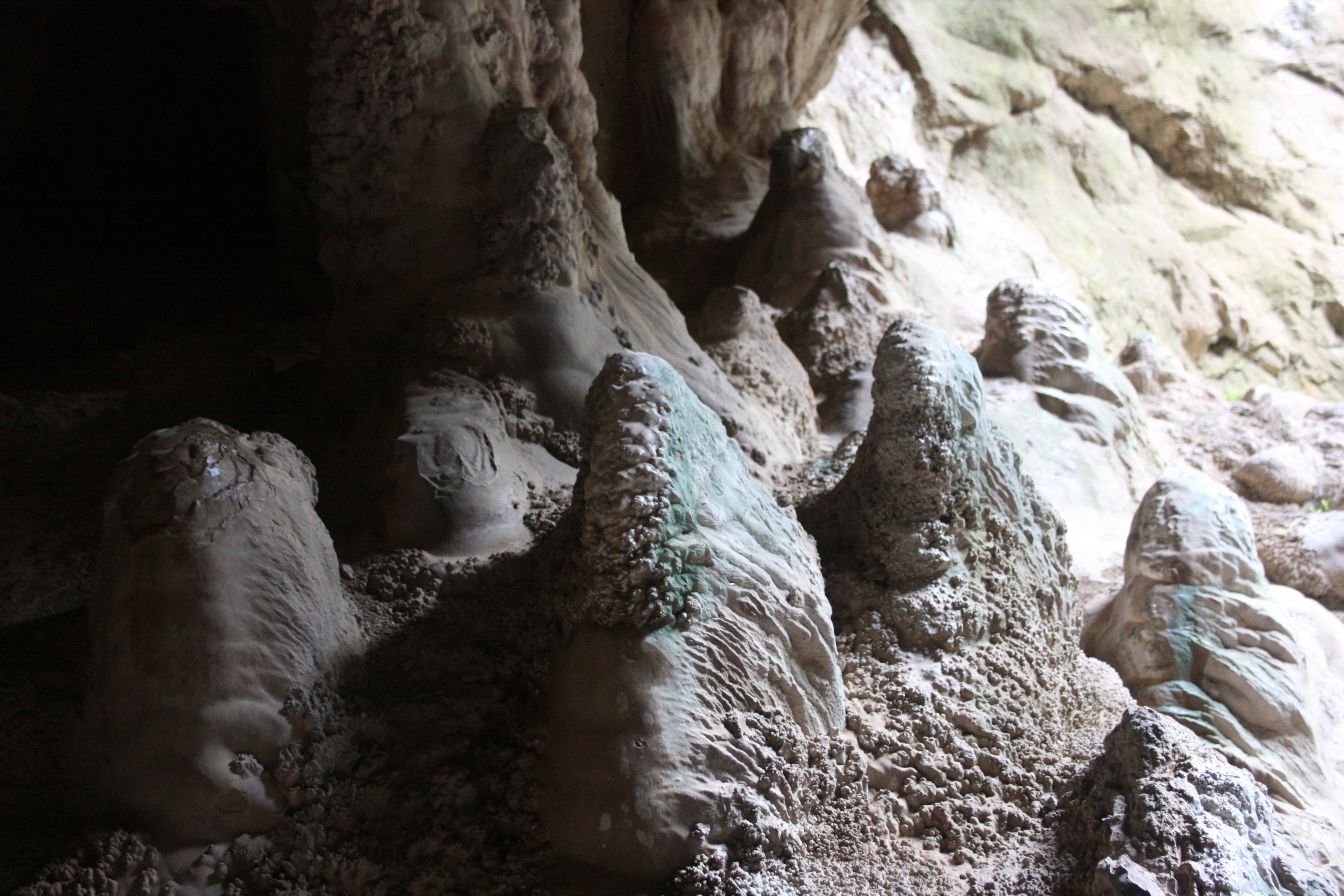
At Jenolan Caves, the path through the Devils Coach House passes by a small collection of stalagmites near the south-eastern entrance. Looking at the photo, note the typical crayback form but also note that some of them have parts missing. This damage is natural, caused by something lifting off parts of the stalagmite, exposing earlier deposited layers.
Layers in stalagmites are sometimes separated by dust, and in this case by the growth of cyanobacteria. When water drips on the surface, it can be absorbed by these dusts or growths. Now consider what may happen in cold wintry conditions when there is a frost. The speleothems are close enough to the entrance to be frosted over. While the water is freezing, it expands a little, and this assists in breaking off small amounts of material loosened from the surface by frost heaving.
| Most of the crayback stalagmites in this photo are intact, but a couple of them at the left of the picture have sections missing from where they were wet, then froze, lifting off layers of speleothem. A closer view of the middle one shows some breakage on its right-hand side, and has a deposit of cave coral, perhaps covering other breakages. The breakage appears to pre-date the cave coral. The left-hand stalagmite is slightly polished. This may be from the feet of animals such as wallabies. |
|
Temperature effects on minerals in Cave Entrances
Cave entrance dusts and crystal heaving were described here: byzoneEntDust.html#Origin. Colchester, Pogson and Osborne (2001) thought that the presence of nitre and sylvite without halite (salt) was characteristic of a deposit containing wallaby droppings which had undergone high evaporation and low temperatures. Reference: Colchester, D., Pogson, R., & Osborne, R. A. L. (2001) "Niter and Sylvite from Jenolan Caves, New South Wales, Australia" in: 13th International Congress of Speleology, Brazil, 2001.
Content updated 28th February 2026.